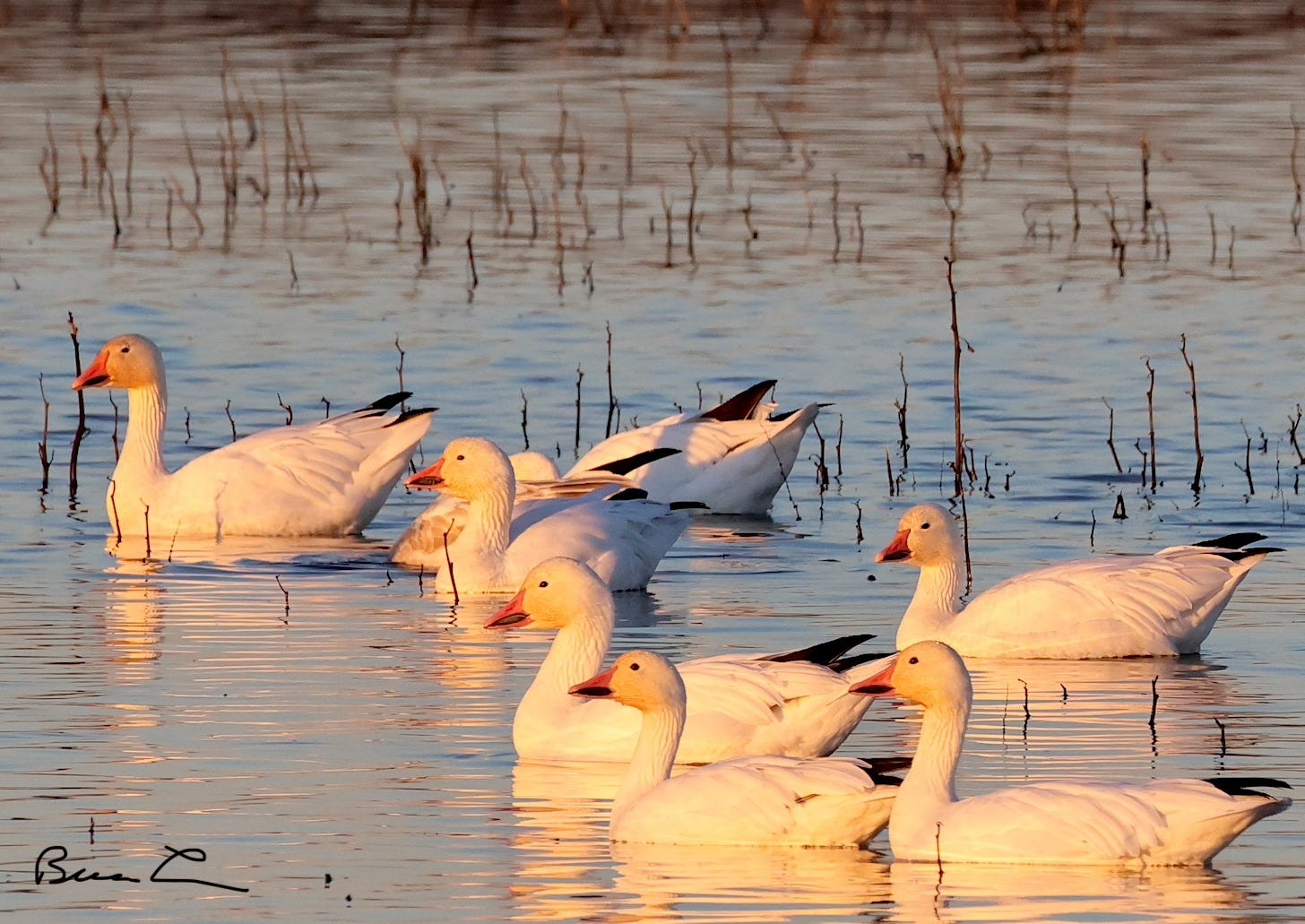
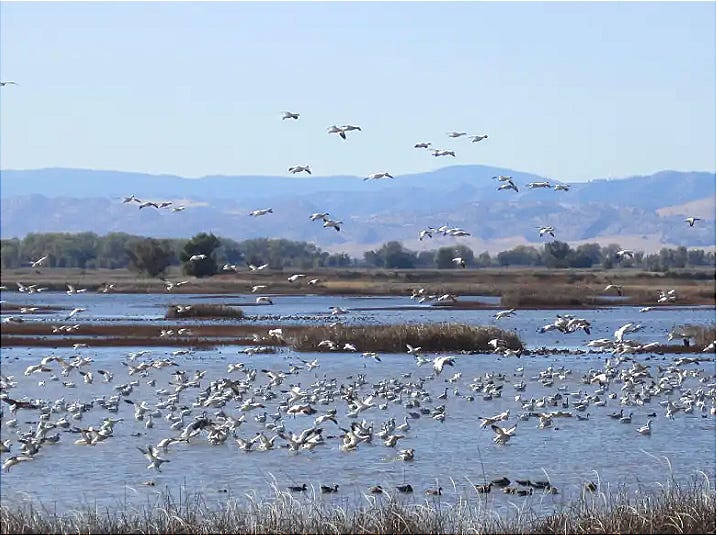
These very snow geese came to California to muck about in shallow waters and marsh bottoms for any plant matter they can get their bills on. (The rust on their heads is staining from iron-oxides pervading the silt and mud).2
The birds have traveled in Vs for thousands of miles, yet their flocks still lift and river through the sky when disturbed or in search of new muck.
We humans, too, are trained to be in certain places on time. In junior high school, any kid coming in late to class had to fill out a slip of paper explaining his tardiness.
One morning, one of my chronically late friends wrote, “Time flies but I don’t.”
Needless to say, our homeroom teacher didn’t accept this excuse and mandated a rewrite. I don’t remember what my friend wrote on his second try, but I do recall that when he was running late another day, he slid down the handrail instead of taking the stairs.
All to save time, until he slipped off and fell on his head.
He suffered a concussion, lay unconscious on the concrete for a bit, and arrived after the bell. Again.
Rushing in late just seemed to be his timing in life.
Last night I spent New Year’s Eve with my husband and a family of decades-long friends in their warm home in our rainy valley.
Our hosts suggested we light a couple dozen votive candles for our new year’s wishes—for good health, a better direction for our nation, and betterment from other personal and professional desires.
As I lit a flame dedicated to finding the vision and courage to complete my memoir-in-progress—a project that’s stirred up all manner of demons and angels in me3—I felt grateful for the chance to begin again in the new year.
Although January can feel like a time of looking both forward and back, like the month’s namesake Janus (Roman god of beginnings and transitions), I’m thinking that 2026 can be a road-transition to renewed creative work.
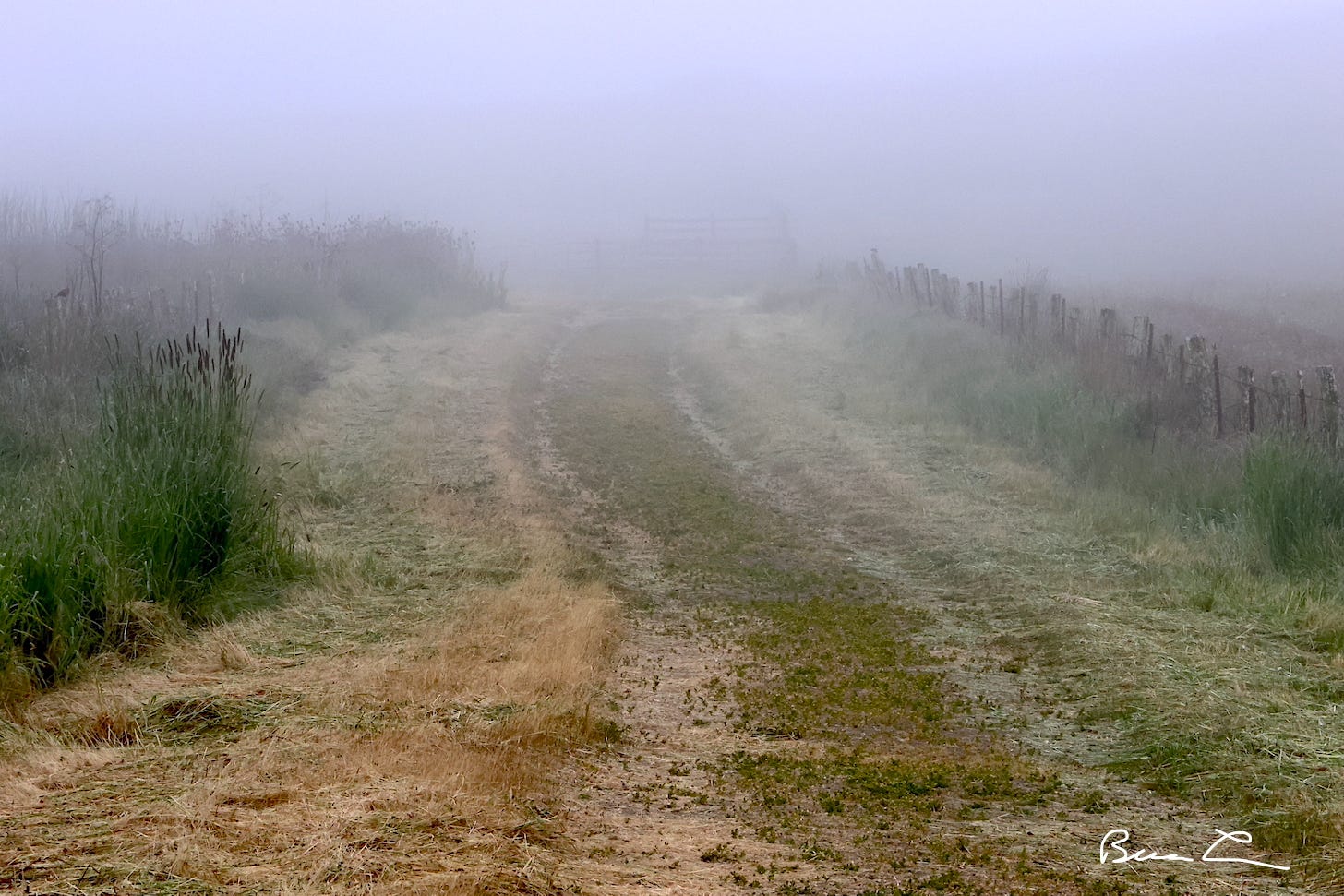
Even if the way isn’t always clear, I can pick up my pen and write the now.
Last spring, my friend and fellow writer Dan Bolster said about his own work-in-progress, which had been delayed: “I believe in the right timing of things.”
Although he’d taken breaks in 2025 for other work and play, he returned to his writing with new vigor each time. He says, “It must be that the book I’m meant to write couldn’t have been finished any earlier.”
I take inspiration from Dan’s confidence in right timing, from the geese who know just when to take flight, and from all of us who went to sleep in an odd-numbered year and woke up with fresh hope in an even one.
In February, as promised in my December 2025 post, “Writing memoir isn’t everything: it only feels that way,” I’ll launch into describing the first of five stages through which some of us (for example, me) pass while memoir writing.
À bientôt!
Events
Thursday, January 8, 2026.Noon Pacific Time.
HOW SHE WROTE IT The Last Cows: On Ranching, Wonder, and a Woman’s Heart First Thursday author conversation with Kathryn Wilder
Join award-winning author Becca Lawton (The Oasis This Time, Torrey House, 2019, and other books) in finding your next story during a day of writing together.
We’ll explore the Center’s flora and fauna, read the works of inspiring desert writers, and put our own words on paper. Optional readings of our new work will give writers fresh experience.
Writers will leave the retreat with the seeds of one or more creative pieces to expand on their own later. Those interested in getting into print will be given strategies and suggestions for next steps in publishing their work.
I truly do believe timing is everything. And if only we are/were aware enough, we'll tiptoe into that next act or room. Best of luck w/ your memoir! It IS an even year, so pull out all the stops! Saludos.
I love the parallels to flight migration. It’s so true that our inner guidance system will tell us when the time is right. And while there’s clearly merit to the ‘show up to the page’ practice, it’s amazing the difference when you find flow state and the work is channeled.





I truly do believe timing is everything. And if only we are/were aware enough, we'll tiptoe into that next act or room. Best of luck w/ your memoir! It IS an even year, so pull out all the stops! Saludos.
I love the parallels to flight migration. It’s so true that our inner guidance system will tell us when the time is right. And while there’s clearly merit to the ‘show up to the page’ practice, it’s amazing the difference when you find flow state and the work is channeled.